
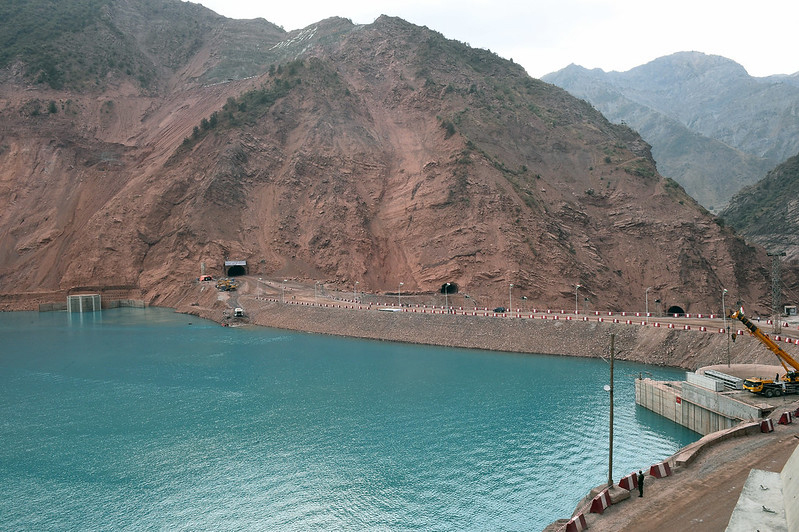
Thirty-three families in the village of Bedikho, Nurobod district, have been told to leave their homes by the end of 2026. Residents say they have received compensation but have not been given enough time to build new homes. The issue goes beyond the physical relocation of families to make way for the Rogun Hydropower Project. The central question is whether the government has provided adequate living conditions elsewhere before demanding that residents leave their village.
According to a Radio Ozodi report published on October 29, authorities have instructed the remaining families to relocate to Tursunzoda and other areas as soon as possible. An anonymous source within the district administration reportedly identified the end of this year as the final deadline. According to the same report, the village is expected to be submerged by August 2027.
Residents allege that the roofs of approximately 20 houses, as well as those of the village school and mosque, were dismantled roughly two weeks before the report was published. Abdugaffor Odinayev, the former head of the village school, said pupils now have to travel seven kilometres to attend classes. Some children, particularly girls, have reportedly stopped attending school altogether. These claims have not been independently verified.
One resident, Ismatullo Rahimov, told Radio Ozodi that housing compensation had been paid in full and that trucks had been offered to assist with relocation. However, he said construction of replacement homes at the new location had not yet begun. Authorities have not explained the reason for the urgency.
This is where the fundamental problem lies. Receiving financial compensation and obtaining a completed, habitable home are two very different stages of resettlement. Money in a bank account does not automatically become walls and a roof, running water, electricity or access to a school. Building a new life requires time, construction materials, skilled labour and adequate infrastructure.
In its official explanation of the Rogun Hydropower Project, the World Bank makes clear that resettlement involves much more than monetary compensation. According to the bank, affected families should have access to quality housing, water, electricity, land and assistance in restoring their livelihoods. Schools, healthcare facilities and other essential social infrastructure must also be capable of serving relocated communities.
The World Bank acknowledges that resettlement on this scale is complex and time-consuming, and that restoring household incomes remains a significant challenge. According to the bank, the Rogun project involves the resettlement of more than 50,000 people.
Concerns about the fate of displaced communities are not new. In a 2014 investigation, Human Rights Watch documented problems involving housing construction, inadequate compensation, the loss of agricultural land, and restricted access to water and education.
That investigation reflects conditions at the time and does not, by itself, establish that the same violations are occurring today. Nevertheless, it demonstrates that the social consequences of displacement associated with major infrastructure projects have been known for years.
If residents’ allegations that roofs were removed before replacement housing became available are confirmed, the issue would go beyond the implementation of a construction timetable. Such actions could amount to administrative pressure on families whose ability to challenge government decisions is severely limited.
The authorities should clarify who ordered the removal of the roofs, which houses were affected and what practical solutions are being offered to families who do not yet have habitable replacement homes.
The situation regarding children’s education is particularly alarming. When a child stops attending school because an entire village is being relocated, the social cost of a hydropower project extends far beyond compensation for houses, buildings and trees.
Travelling seven kilometres to school in mountainous terrain, especially as winter approaches, is not a minor inconvenience. It is a serious burden on children and their families. The fact that people in Tajikistan have become accustomed to hardship and injustice cannot justify such conditions.
Access to education is a crucial test of whether children’s interests have genuinely been taken into account in resettlement planning.
There may be legitimate safety reasons for accelerating the relocation. If flooding or another immediate threat exists, the authorities should explain the risks through technical assessments and present a clear plan for safely accommodating affected families.
Yet even an urgent need to evacuate does not eliminate the government’s responsibility to address temporary housing, rental expenses and the uninterrupted education of children.
The situation in Bedikho should also prompt a specific review by institutions involved in financing the project. The World Bank reports that grievance mechanisms and independent monitoring arrangements are in place to oversee resettlement.
However, the effectiveness of these mechanisms should not be measured by the number of documents produced or meetings held. They must demonstrate tangible results, including where each family will live once the village is evacuated and which schools their children will attend.
The success of the Rogun Hydropower Project can be measured by the height of its dam, the volume of its reservoir and the amount of electricity generated. But the quality of the project’s governance must also be judged by the fate of the people forced to leave their homes.
A government capable of mobilising enormous financial and technical resources to build a hydropower plant must also be capable of finding a safe and dignified solution for 33 families in Bedikho.
Before tens of thousands of people are required to abandon their hometowns and ancestral homes, they should be guaranteed at least the most basic conditions for rebuilding their lives, beginning with completed housing fit for habitation.
Progress on the Rogun Hydropower Project must not come at the cost of leaving tens of thousands of people without secure homes, forcing them to bear the consequences of government decisions on their own.


