Tajikistan’s economy is growing at a pace many countries can only dream of. Most European countries do not enjoy such high economic growth rates. But how much of that growth reaches the family dinner table? Are wages sufficient to cover everyday expenses? Are new jobs being created? Is dependence on labour migration declining? And is there anyone in the corridors of government willing to answer these questions?
Frankly, the World Bank can sometimes be difficult to understand. It often seems to treat the Tajik government’s economic statistics as a reliable basis for its conclusions without paying enough attention to whether those impressive figures translate into tangible improvements in people’s daily lives. Are independent checks being carried out to establish how closely Tajikistan’s extraordinary reported growth corresponds to reality?
Consider this: the World Bank estimates that Tajikistan’s economy grew by 8.2% in the first half of 2026. Now let us compare that figure with economic growth rates in several European countries.
I make no claim to being an economist. But I believe every citizen has both the right and the responsibility to develop at least a basic understanding of the economic statistics governments use to celebrate their achievements.
What follows, therefore, is not a professional economist’s assessment. It is the perspective of an ordinary citizen. If you find a mistake or an inaccurate interpretation, please point it out. Criticism helps us correct errors and improve our understanding.
Tajikistan’s economic growth is indeed remarkably high compared with that of several developed European countries.
The International Monetary Fund growth figure cited in the forecasts under discussion puts Tajikistan’s economy at 7.3% growth in 2026. That is lower than the World Bank’s reported 8.2% for the first six months, although the two figures cover different periods: one is a full-year projection, while the other reflects half-year performance.
The corresponding growth figures cited for Germany are 1.3%, Italy 0.8%, Austria 0.6% and France just 0.4%. Even Spain, at 2.5%, and Lithuania, at 2.7%, trail far behind Tajikistan in percentage terms.
Of course, economic growth and living standards are not the same thing.
A smaller economy can achieve high percentage growth from a low starting point, while a large, advanced economy may generate far greater additional output and income despite growing at a much lower percentage rate.
Yet the crucial question remains: how far is Tajikistan’s rapid economic growth translating into adequate wages, secure employment and better living conditions for its people? Is that not worth asking?
In any case, the World Bank itself acknowledges that remittance inflows and household consumption are among the principal drivers of Tajikistan’s economic growth.
In other words, behind the impressive economic statistics lies the hard work of migrant labourers.
What kind of economic miracle is this if it depends so heavily on the earnings of the very workers commonly dismissed as gastarbeiters, people forced to seek employment abroad?
Certainly, household consumption can genuinely stimulate economic growth. That is entirely understandable.
But an ordinary consumer may remain in Tajikistan until the family wallet is almost empty, only to borrow money for the journey back abroad in search of work.
Moreover, an increase in industrial production or construction does not automatically mean that every household’s income has grown by the same amount.
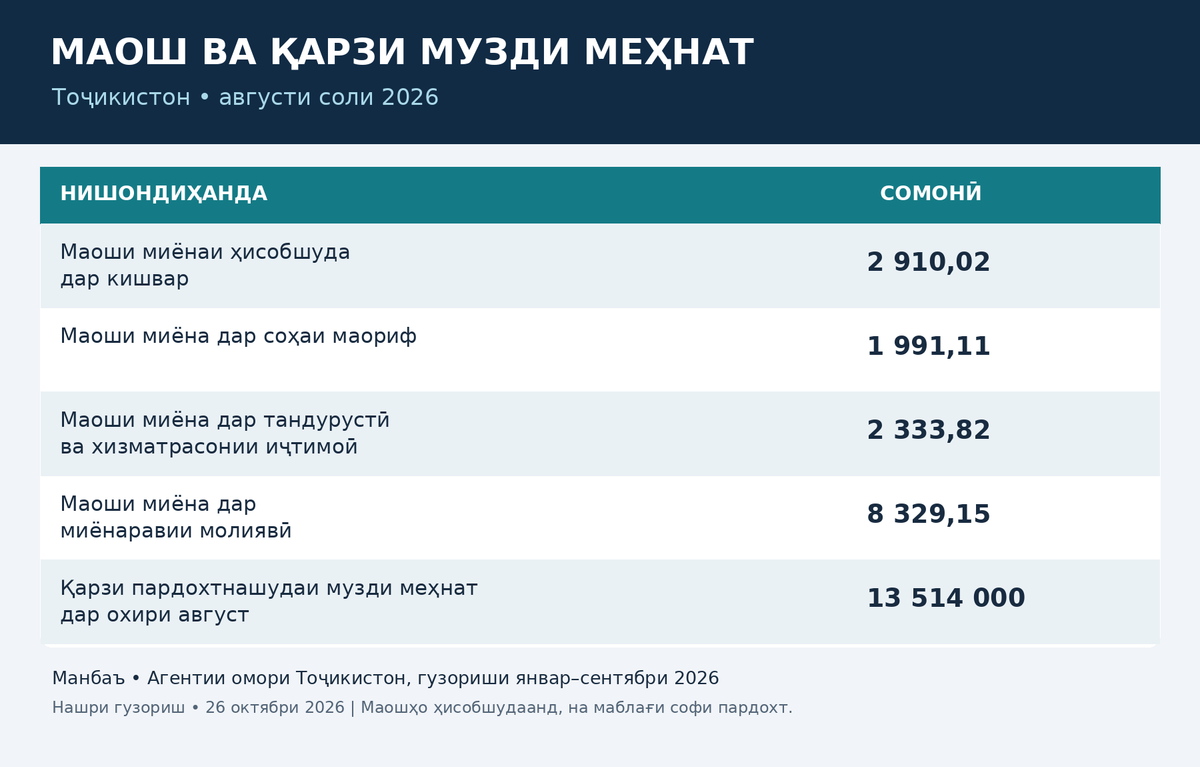
Let us now examine the figures published by Tajikistan’s Agency on Statistics on October 26 and consider how much of the growth recorded on paper is reflected in people’s actual lives.
Payom TV illustration: Wages across sectors of Tajikistan’s economy
These wage figures refer to August 2026, although they appear in the January–September statistical report.
A simple calculation shows that average wages in the financial sector are approximately 4.2 times higher than in education. The average wage in education is also about 32% below the national average.
These comparisons do not describe the income of every individual teacher or banking employee, but they clearly reveal the gap between different sectors.
And they offer a telling indication of how highly teachers are valued in Tajikistan.
It is also important to remember that the term “average wage” can be misleading. It does not necessarily represent what most people actually earn.
A relatively small number of extremely high salaries can significantly raise the arithmetic average.
Consider, for example, the controversy surrounding the pension of Amonullo Hukumov, the former head of Tajikistan’s railway company.
Back in 2015, Radio Ozodi reported that Hukumov’s monthly pension amounted to 18,000 somoni, approximately $3,500 at the exchange rate of the time.
If that pension had been calculated at 60% of his previous salary, his estimated monthly salary would have been around 30,000 somoni, or approximately $5,500 at the exchange rate then in effect.
This is a hypothetical calculation, not independently documented evidence of his actual salary.
At the time, the average monthly wage in the education sector was approximately 710 somoni.
Under that assumption, Hukumov’s calculated salary would have been equivalent to the combined earnings of about 42 education-sector employees.
His pension of 18,000 somoni alone would have equalled almost 25 months of an average education worker’s salary.
Quite an extraordinary comparison!
Even these average wage figures do not necessarily represent the amount an employee actually takes home after deductions.
To understand living standards, we must also consider total household income and the number of people dependent on it.
Imagine a family of five living on a single salary equivalent to the education sector’s average, approximately 1,990 somoni a month.
That would leave about 398 somoni per family member per month.
This is an illustrative calculation rather than a statistical description of Tajik households. Nevertheless, it demonstrates why wage figures alone tell us little without information about family size and dependants.
One of the government’s recurring arguments is that people’s purchasing power is increasing.
The reasoning is simple: people are buying goods, so they must have money. If they had no money, they would not be buying anything.
But increased consumption does not necessarily mean a comfortable or financially secure life.
A household may buy slightly more than it did a year earlier while still borrowing money for medical treatment, rent or children’s education.
The general consumer price index does not precisely reflect the expenses faced by every individual family either.
The central problem is employment.
According to the World Bank, Tajikistan’s employment-to-working-age-population ratio is approximately 36%.
This should not be interpreted as a 64% unemployment rate. People may be outside employment for many different reasons.
Nevertheless, the figure highlights the relatively limited proportion of the working-age population that is employed.
The World Bank also estimates that migrant remittances amounted to approximately 46% of Tajikistan’s gross domestic product in 2025.
This does not mean that 46% of Tajikistan’s domestic output was produced abroad.
Rather, the comparison illustrates the enormous scale of money flowing into households from other countries and the depth of Tajikistan’s dependence on migrant earnings.
UN Independent Expert Attiya Waris addressed precisely this problem in an August 31, 2026 statement:
“Remittances have supported families, household consumption and poverty reduction, but they cannot substitute for sufficient, decent and productive employment at home.”
According to the economic statistics, poverty in Tajikistan continues to decline despite repeated shocks to the global economy.
The World Bank estimates that approximately 14.8% of the population lived below the international poverty line of $4.20 per day in 2025. The figure of 13.2% for 2026 is a projection, not a final measured outcome.
There is, however, an important methodological distinction.
The $4.20 international poverty line is expressed in 2021 purchasing power parity, or PPP, dollars. It is not calculated simply by converting household income from somoni into US dollars at the market exchange rate.
A direct comparison between a nominal salary converted at the exchange rate and that international poverty threshold would therefore be misleading.
Even so, let us consider an illustrative example to understand how limited a large family’s financial resources can be.
Suppose a schoolteacher has five children. Including the teacher and spouse, the household has seven members, with the teacher as its only wage earner.
If the teacher earns around 2,000 somoni per month, dividing that salary among seven people leaves approximately 286 somoni per person per month.
Dividing that by 30 days gives roughly 9.52 somoni per person per day, approximately one US dollar at an illustrative market exchange rate.
This is not a poverty calculation under the World Bank’s methodology. Such an assessment would require information about total household consumption and the appropriate purchasing power parity conversion.
The example nevertheless shows how limited a family’s monetary resources may be even when one member is employed.
How many education workers have incomes sufficient to provide a decent standard of living for all members of their families?
Even in the highest-paid banking sector, we cannot automatically conclude that employees are financially secure without knowing the size of their households and their total resources.
This is why citizens should do more than simply accept official percentages showing reductions in poverty.
They should understand what those figures actually measure, how they are calculated and how closely they reflect people’s everyday expenses.
Our argument, then, is not about denying that economic growth exists.
It is about the quality of that growth and its real impact on society.
If economic expansion does not produce decent jobs, sufficient wages and accessible public services, ordinary people have every right to ask: where are all these spectacular achievements?
The government should not limit itself to announcing impressive GDP growth figures.
It should show how many families can sustain themselves on income earned within Tajikistan, how many people are forced to migrate out of economic necessity, and which groups remain excluded from the benefits of development.
A successful economy is not measured merely by the height of the bars on statistical charts. It must be judged by the lives of the people those statistics are supposed to serve.
Shavkati Muhammad